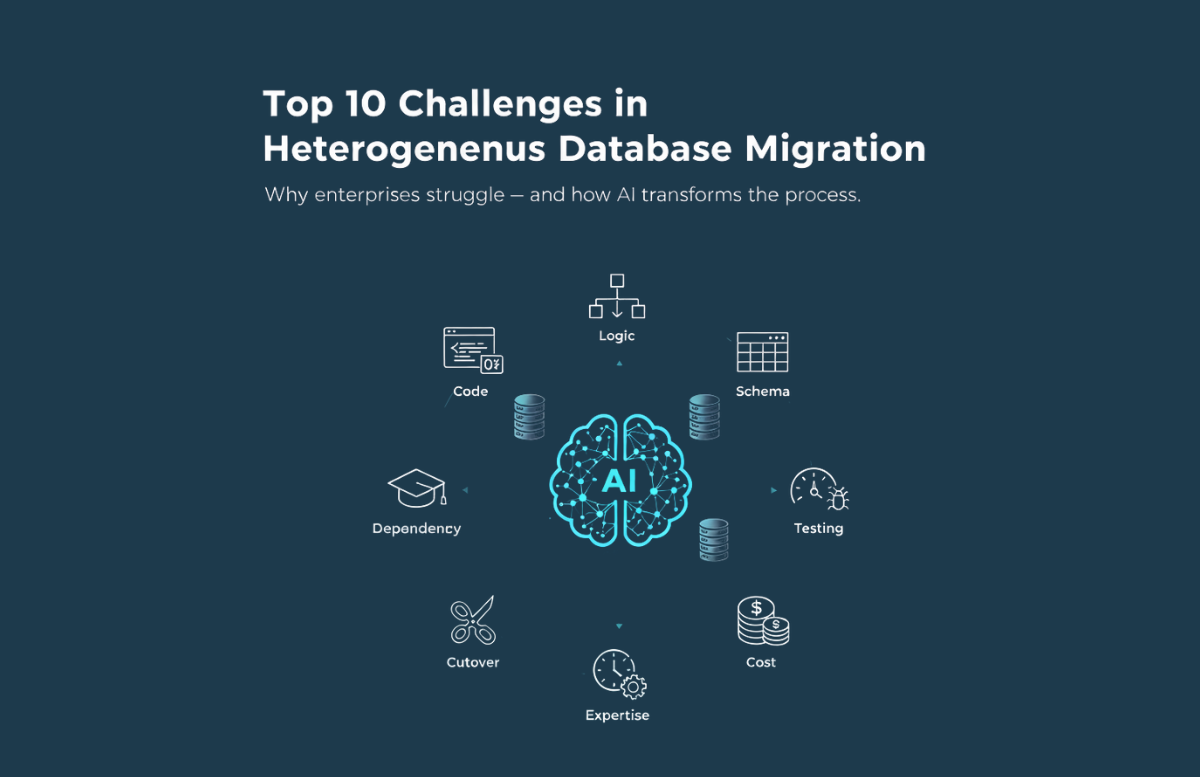
Heterogeneous database migration—moving from one database engine to another such as Oracle → PostgreSQL or SQL Server → PostgreSQL—is one of the most complex, high-risk operations in enterprise IT. Unlike homogeneous migrations (e.g., Oracle → Oracle), heterogeneous migrations involve deep architectural differences, incompatible SQL dialects, and unpredictable application behavior after cutover.
Below are the 10 biggest challenges enterprises face, and insights on how modern AI-driven tools can help overcome them.
1. Manual Code Rewrites Take Too Long
Each database uses its own SQL dialect:
- Oracle → PL/SQL
- SQL Server → T-SQL
- PostgreSQL → PL/pgSQL
A single large application may contain:
- Thousands of stored procedures
- Complex triggers
- Functions and packages
- Nested business logic
Manual rewriting becomes:
- Time-consuming
- Error-prone
- Dependent on rare expertise
- Costly for large enterprises
AI-based refactoring tools accelerate this by automatically analyzing, rewriting, and validating SQL code at scale.
2. Business Logic Doesn’t Transfer Cleanly
The hardest part of migration is not tables—it’s logic.
Triggers, custom functions, loops, exception handling, cursor behavior… all work differently across engines.
This leads to:
- Logic inconsistencies
- Unexpected runtime errors
- Application downtime
Modern tools use intent-based conversion, meaning they understand the purpose of the logic—not just the syntax.
3. Schema Mismatches Break Applications
Every engine handles:
- Data types
- Constraints
- Sequences
- Indexes
- Partitioning
…in unique ways.
Common issues include:
❌ NUMBER vs DECIMAL mismatches
❌ Unsupported check constraints
❌ Sequence behavior differences
❌ Changed default values
An intelligent schema mapping engine ensures structural compatibility before deployment.
4. SQL Performance Drops After Migration
What runs fast in Oracle may run slow in PostgreSQL because:
- Execution planners differ
- Indexing rules change
- Join strategies behave differently
- Optimizer hints don’t translate
If queries are translated “mechanically,” performance issues are guaranteed.
AI-driven engines don’t just translate SQL—they optimize it for the target engine.
5. No Automated Testing Means High Risk
Without automated validation, enterprises may face:
- Undetected logic errors
- Broken stored procedures
- Wrong output for edge cases
- Inconsistent data states
Manual testing covers only 10–20% of logic paths.
Modern systems provide automated schema checks, code validation, and side-by-side output comparison.
6. Migrations Take Too Long
Typical enterprise-scale migrations take:
- 6–18 months (medium systems)
- 2–3 years (large systems)
Why?
- Manual rewrites
- Slow testing cycles
- Multiple UAT rounds
- Fix-retest loops
Parallel processing and AI automation slash migration timelines by 70–90%.
7. Skilled Cross-Database Experts Are Limited
Experts who know Oracle and PostgreSQL deeply are rare.
They’re expensive, and enterprise demand far exceeds supply.
This causes:
- Slow fixes
- High costs
- Project delays
AI tools democratize migration knowledge, enabling teams with basic SQL experience to execute complex migrations confidently.
8. Hidden Dependencies Cause Deployment Failures
If the deployment order is wrong, the migration breaks.
Examples:
- Views require base tables
- Functions require dependent functions
- Sequences must be created before triggers
- Packages may contain nested dependencies
Automatic dependency analysis ensures objects deploy in the correct sequence.
9. Cutover Risks Are High
A bad cutover can mean:
- Broken applications
- Incorrect queries
- Downtime
- Costly rollbacks
Most cutover failures happen due to:
- Incomplete validation
- Logic mismatches
- Schema differences
- Incorrect data transformations
AI-driven pre-cutover validation reduces uncertainty and increases reliability.
10. Project Costs Spiral Out of Control
Enterprises overspend due to:
- Long timelines
- High specialist costs
- Rework cycles
- Extended testing
A multi-year migration can cost millions.
AI automation reduces manual workload, timeline, and specialist dependency—leading to 60–80% cost savings.
How ProGres MigrateAI™ Helps Overcome These Challenges
Understanding the challenges is only half the battle. Successfully executing a heterogeneous database migration at enterprise scale requires automation, intelligence, and repeatability—areas where traditional tools and manual approaches fall short.
ProGres MigrateAI™ by Accuract Technologies is an AI-powered migration platform designed specifically to tackle the real-world challenges discussed above, including complex code rewrites, schema incompatibilities, performance degradation, and cutover risk.
How ProGres MigrateAI™ Addresses Enterprise Migration Pain Points
- Automated Code Refactoring Across Engines
Converts stored procedures, functions, triggers, and packages using AI-driven logic interpretation—eliminating months of manual rewriting. - Intelligent Business Logic Preservation
Ensures functional equivalence by understanding intent, not just SQL syntax, reducing runtime errors post-migration. - Advanced Schema & Dependency Mapping
Automatically maps data types, constraints, sequences, and dependencies to ensure correct object creation order and structural compatibility. - Built-In Performance Optimization
Optimizes translated SQL for the target database engine, addressing execution plan differences and indexing behavior. - Automated Testing & Validation
Performs side-by-side validation of source and target outputs, significantly reducing cutover risk. - Faster Timelines with Lower Risk
Compresses migration timelines by up to 90% while reducing dependency on scarce cross-database experts. - Controlled Costs and Predictable Outcomes
Minimizes rework, shortens testing cycles, and delivers 60–80% cost savings compared to manual migration approaches.
By addressing the most complex aspects of heterogeneous database migration in a single platform, ProGres MigrateAI™ enables enterprises to migrate with confidence, speed, and accuracy—without disrupting business operations.
Final Thoughts
Heterogeneous migration is challenging, but it doesn’t have to be slow, risky, or unpredictable.
AI-powered migration platforms now automate the most painful parts: code rewrites, validation, performance tuning, dependency resolution, and schema mapping.
Teams can finally migrate confidently—with predictable timelines and enterprise-grade accuracy.
Frequently Asked Questions (FAQs)
1. What is heterogeneous database migration?
Heterogeneous database migration is the process of moving databases between different database engines, such as Oracle to PostgreSQL or SQL Server to PostgreSQL. Unlike homogeneous migrations, it involves differences in SQL dialects, data types, schema structures, and execution behavior, making it significantly more complex.
2. Why is heterogeneous database migration more challenging than homogeneous migration?
3. What are the biggest risks in heterogeneous database migration?
Common risks include business logic loss, schema incompatibilities, performance degradation, hidden dependencies, incomplete testing, and failed cutovers. Without automation and validation, these issues can lead to downtime and costly rollbacks.
4. Can heterogeneous database migration be fully automated?
While no migration is 100% push-button, modern AI-powered platforms can automate most of the process—especially code conversion, dependency analysis, schema mapping, testing, and validation—reducing manual effort dramatically.
5. How does AI improve database migration accuracy?
AI analyzes patterns, intent, and logic rather than relying on rule-based translation alone. This enables more accurate code conversion, better performance optimization, and early detection of inconsistencies across source and target databases.
6. How long does an enterprise-scale heterogeneous migration usually take?
Traditional migrations can take anywhere from 6 months to several years, depending on system complexity. AI-driven migration platforms can reduce timelines by up to 70–90% by parallelizing tasks and automating validation.
7. What databases are commonly involved in heterogeneous migrations?
Common migration paths include Oracle to PostgreSQL, SQL Server to PostgreSQL, Oracle to MySQL, and legacy database systems moving to open-source or cloud-native platforms.
8. How is performance ensured after migration?
Performance is ensured through query optimization, indexing strategy alignment, and engine-specific tuning. AI-driven tools analyze execution plans and rewrite SQL to suit the target database’s optimizer behavior.
9. What role does testing play in heterogeneous database migration?
Testing is critical. Automated testing validates schema integrity, business logic, and query outputs by comparing source and target results, significantly reducing cutover risk and post-migration defects.
10. How does ProGres MigrateAI™ help with heterogeneous database migration?
ProGres MigrateAI™ by Accuract Technologies uses AI to automate code conversion, preserve business logic, map schemas intelligently, analyze dependencies, optimize performance, and validate migrations—enabling faster, safer, and more cost-effective migrations.
11. Is ProGres MigrateAI™ suitable for large enterprise systems?
Yes. ProGres MigrateAI™ is designed for complex, large-scale enterprise environments with thousands of database objects, deep dependencies, and mission-critical workloads.
12. When should organizations start planning a heterogeneous migration?
Planning should begin well before licensing renewals, cloud modernization initiatives, or legacy system upgrades. Early assessment helps reduce risk, control costs, and ensure a smoother transition.